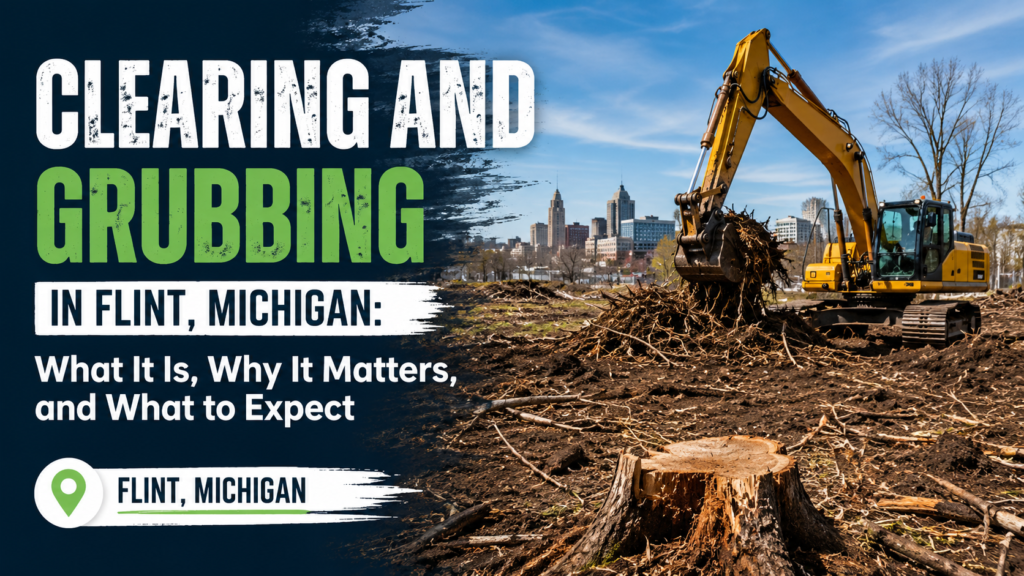
When land is prepared for development, construction, or revitalization particularly in a city like Flint, Michigan, where vacant lots and redevelopment projects are a central part of community improvement efforts Clearing and grubbing Flint is one of the most essential early steps in the process. Though these terms are sometimes used interchangeably, they refer to two distinct but closely related operations that together prepare a site to receive infrastructure, landscaping, or new construction.
What Is Land Clearing?
Land clearing is the first stage of site preparation. It involves the removal of above-ground vegetation, trees, shrubs, brush, and other surface obstructions from a property. The goal is to create an accessible, manageable work area from which subsequent operations can proceed. In Flint, where vacant parcels may have been left unmaintained for years or even decades, clearing can involve the removal of large trees, extensive brush growth, and accumulated surface debris.
Clearing is typically performed using heavy equipment including bulldozers, forestry mulchers, and excavators. The approach depends on the density and type of vegetation, the size of the parcel, and the proximity of adjacent structures. In urban environments like Flint, where lots may sit beside occupied homes or active commercial properties, clearing operations require careful planning to minimize impact on neighbors.
What Is Grubbing and How Does It Differ from Clearing?
While clearing addresses what is visible above the ground, grubbing deals with what lies beneath the surface. Grubbing is the process of removing tree stumps, root systems, buried logs, and other organic material that remains in the soil after clearing is complete.
The distinction matters enormously for construction purposes. If roots and organic material are left in the soil, they will decompose over time, creating voids and causing the ground to settle or shift unevenly. This can lead to structural problems in buildings, cracked foundations, heaved pavement, and drainage failures. Grubbing ensures that the soil is stable and free of decomposable material before development proceeds.
Grubbing involves excavators, root rakes, and stump grinders to extract and remove underground material to the specified depth typically to a depth of at least 12 to 18 inches, or deeper for larger root systems.
Why Clearing and Grubbing Is Critical in Flint’s Redevelopment Context
Flint has seen significant urban redevelopment activity in recent years, including the demolition of blighted structures and the preparation of vacant land for new uses. Many of the parcels undergoing development were previously occupied by structures that have since been demolished, or they have been vacant for extended periods during which vegetation has grown unchecked.
In these scenarios, clearing and grubbing serve multiple purposes:
- Removing biological hazards such as overgrown vegetation that can harbor pests or impede inspection of the site.
- Eliminating structural roots that could interfere with new foundation work or underground utilities.
- Creating the clean, level base required for grading, drainage installation, and new construction.
- Allowing site engineers and surveyors to work safely and accurately on the prepared surface.
Permits and Environmental Considerations in Michigan
In Michigan, clearing and grubbing operations are subject to state and local regulations, particularly when the work involves areas near waterways, wetlands, or environmentally sensitive habitats. The Michigan Department of Environment, Great Lakes, and Energy (EGLE) oversees permits for land clearing activities that could affect water quality or protected land features.
In Flint specifically, properties that are part of brownfield redevelopment programs may involve additional environmental reviews before vegetation removal can begin. Contractors working on these sites must be familiar with applicable permit requirements and environmentally responsible disposal methods for cleared material.
Michigan also has guidelines around clearing near waterways. Land clearing within 500 feet of a lake or stream, or on parcels larger than one acre, may require specific permits. Professional clearing contractors in the Flint area are experienced in identifying these requirements early in the project planning process.
Equipment Used in Clearing and Grubbing Operations
The scope and terrain of the clearing project determines which equipment is deployed. Common machinery used in clearing and grubbing operations includes:
- Bulldozers: Used to push and pile large volumes of vegetation, stumps, and debris on larger open sites.
- Forestry mulchers: Specialized machines that grind trees and brush into mulch in a single pass, reducing debris volume significantly.
- Excavators: Used for grubbing operations, pulling stumps, and removing large root masses.
- Dump trucks: Required to haul cleared and grubbed material to disposal or recycling facilities.
- Stump grinders: Used in urban settings where full excavation of stumps is impractical and grinding to below-grade level is sufficient.
What Happens to the Cleared Material?
Cleared vegetation and grubbed root material must be disposed of responsibly. In Michigan, burning of cleared material is regulated and typically requires a permit. Most professional clearing operations in the Flint area use one or more of the following disposal methods:
- Chipping and mulching: Trees and brush are processed into wood chips that can be used as ground cover, composted, or sold as biomass.
- Hauling to disposal sites: Material is transported to permitted landfill or composting facilities.
- On-site burial: In some large, rural projects, cleared material may be buried in designated areas of the property. This is typically not appropriate for urban lots in Flint.
The Relationship Between Clearing, Grubbing, and Subsequent Site Work
Clearing and grubbing set the stage for every other phase of site development. Once the surface and sub-surface are clean, grading operations can establish proper drainage and elevation. Utilities can be trenched and installed. Foundations can be excavated and formed. Pavement bases can be prepared.
When clearing and grubbing are done thoroughly and correctly, every subsequent stage of the project proceeds more efficiently. When they are rushed or incomplete, problems compound roots interfere with grading equipment, hidden stumps create settlement points under pavement, and organic material left in the soil causes long-term instability.
Conclusion
Clearing and grubbing in Flint, Michigan is a specialized service that plays a critical role in both residential and commercial site development. It is particularly significant in the context of Flint’s ongoing urban revitalization, where vacant and neglected parcels are being transformed into productive properties. Understanding what clearing and grubbing involve, why both stages are necessary, and how they connect to subsequent construction work empowers property owners, developers, and community organizations to plan responsibly and achieve lasting results.